Chopta Tungnath Trek: Where the Mountains Call You by Name
There are treks you do for the photos. And then there are treks that quietly change something inside you — the ones where the mountain air gets into your lungs and refuses to leave. Chopta Tungnath Trek is the second kind.
Tucked deep inside Uttarakhand’s Rudraprayag district, Chopta is not a place you stumble upon. You choose it. And once you do, it chooses you right back.
What Makes Chopta Different from Every Other Hill Station?
Most hill stations in India feel like they are performing for you — crowded markets, loud hotels, selfie queues. Chopta is the exact opposite. It does not try. It simply exists, spread across a green meadow at over 2,700 metres, wrapped in oak and rhododendron forests, with the snow-covered Himalayan peaks sitting behind it like they own the sky.
Locals call it the “Mini Switzerland of Uttarakhand.” Honestly, that comparison undersells it. Switzerland does not have Tungnath.
Tungnath — The Highest Shiva Temple in the World
At an altitude of roughly 3,680 metres, Tungnath is not just a trek destination — it is a spiritual experience wrapped inside a physical challenge.
This ancient stone temple is dedicated to Lord Shiva and holds a place in the Panch Kedar pilgrimage circuit. Whether you are a believer or not, standing at Tungnath and watching the sun hit the peaks of Nanda Devi, Trishul, and Chaukhamba is an experience that does not need religious context to feel sacred.
The trail from Chopta to Tungnath is approximately 3.5 kilometres one way. It sounds manageable on paper. In reality, it is a steady uphill climb through thick forests that slowly open up into rocky, open terrain as you gain altitude. Every turn of the trail reveals a new angle of the mountains. You will stop walking just to stare. That is not weakness — that is the trail doing its job.
Chandrashila Peak — The Crown Above Tungnath
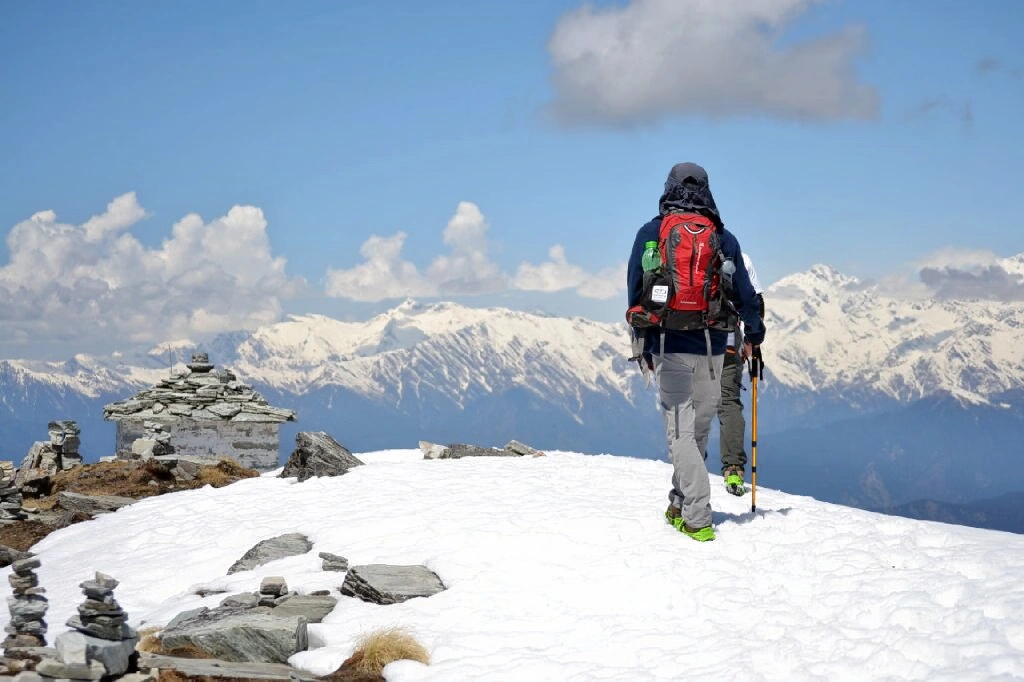
Most trekkers stop at Tungnath. The ones who push further — another kilometre uphill to Chandrashila Peak at approximately 4,000 metres — get rewarded in a way that is very hard to describe without sounding dramatic.
From Chandrashila, on a clear day, you get a 360-degree view of the Greater Himalayas. Kedarnath Peak, Nanda Devi, Trishul, Bandarpunch, and Chaukhamba — all visible at once. There is no railing, no safety rope, no crowd. Just you, the wind, and an uninterrupted wall of white peaks stretching across the horizon. Chopta Tungnath Trek
This is why people come back to Chopta Tungnath Trek every single time.
The Trek Route — Step by Step
Base Camp: Chopta Your journey starts at Chopta meadow. Spend the night before your trek here. Wake up early — not because you have to, but because Chopta at dawn is a completely different world. The mist sits low over the meadow, the birds are loud, and the forest smells like cold and pine and something you cannot name.
Chopta to Tungnath (3.5 km | 2–3 hours) The trail begins right from the meadow. The first section passes through dense forests of oak, rhododendron, and buransh. In spring, when the rhododendrons are in bloom, this entire section turns red and pink — it is genuinely one of the most beautiful walking paths in India.
As you gain altitude, the trees thin out. The path gets steeper and rockier. You will feel your heart working harder. Take your time. Drink water. Look back — the view behind you is already spectacular before you even reach the top. Chopta Tungnath Trek
The temple comes into view suddenly, around a bend in the trail. The sight of its stone walls against the open sky tends to stop people mid-step.
Tungnath to Chandrashila Peak (1 km | 45–60 minutes) This final stretch is the steepest part. Rocky, exposed, and demanding — but absolutely worth it. The summit gives you everything.
Return: Chandrashila to Chopta (4.5 km | 2.5–3 hours) Coming down is faster but requires careful footing, especially on the rocky sections near Chandrashila.
Best Time to Do the Chopta Tungnath Trek
March to June — Spring & Early Summer This is perhaps the most visually stunning window. The rhododendron forests are in full bloom, the skies are relatively clear, and the snow is still present on higher sections without being dangerously heavy. Temperatures are comfortable during the day.
September to November — Post-Monsoon Autumn After the monsoon clears, Chopta transforms into something truly spectacular. The meadows are lush green, the air is crystal clear, and the mountain views are at their sharpest. This is a favourite season for photographers and serious trekkers.
December to February — Winter Snow Trek For those who want a completely different experience — Chopta in winter is covered in deep snow. The trail becomes a snow walk. Temperatures drop sharply, especially at night. This is not for beginners, but for experienced cold-weather trekkers, winter Chopta is unforgettable. Note that Tungnath temple closes during peak winter — but the trek and views remain. Chopta Tungnath Trek
How to Reach Chopta
From Delhi by Road Delhi → Rishikesh → Devprayag → Rudraprayag → Ukhimath → Chopta
Total distance is approximately 450–470 km. By car, plan for a 12–14 hour drive depending on stops and road conditions. The road after Rudraprayag is mountain terrain — winding and scenic but requires careful driving. Chopta Tungnath Trek
By Train + Road The nearest major railway station is Rishikesh or Haridwar. From there, hire a cab or take a shared vehicle towards Ukhimath, and then onward to Chopta.
By Bus UPSRTC and private buses run from Delhi to Rishikesh or Haridwar. From there, local cabs or shared taxis take you further. This is the most budget-friendly option.
Trek Difficulty — Who Can Do This?
Chopta Tungnath is classified as an easy to moderate trek. Here is what that actually means:
- No technical climbing or rope sections
- Trail is clear and well-marked
- Altitude gain is gradual and manageable
- Suitable for beginners with basic fitness
- Children above 8–10 years with adult supervision can manage up to Tungnath
However, “easy to moderate” does not mean effortless. The altitude will affect people differently. If you live at sea level, the last stretch to Chandrashila will make your lungs work hard. Good fitness, proper hydration, and a slow, steady pace are your best preparation. Chopta Tungnath Trek
What to Pack — The Practical List
Clothing
- Thermal base layers (even in summer — nights get cold)
- Fleece mid-layer
- Windproof/waterproof jacket
- Trekking pants (avoid jeans — they are heavy and take forever to dry)
- Warm socks (2–3 pairs)
- Gloves and a warm hat or beanie
- Sun hat or cap for daytime
Footwear
- Sturdy trekking shoes with ankle support (this is non-negotiable)
- Camp sandals or flip-flops for the evening
Gear & Essentials
- Trekking poles (optional but very helpful on descent)
- Daypack (20–30 litres is enough)
- Water bottles — at least 1.5 to 2 litres capacity
- Headlamp with extra batteries
- Sunscreen (SPF 50+) and lip balm
- Basic first aid kit
- Personal medicines
- Energy snacks — dry fruits, nuts, chocolates, energy bars
- Rain cover for your bag
Documents & Money
- Valid ID proof
- Cash — there are no ATMs in Chopta
Where to Stay in Chopta
Chopta has a handful of basic guesthouses and camping options. Do not expect luxury — but that is also the point. Most accommodations here are simple, warm, and run by local families who know the mountain and can share stories no travel guide will give you. Chopta Tungnath Trek
Camping is highly recommended if the weather permits. Waking up inside a tent with the Himalayan peaks visible from your sleeping bag is the kind of morning that makes you question every life decision that previously kept you away from mountains.
For a more comfortable option, several tour operators — including Idea Vacation — offer packages that include accommodation, meals, and guided treks from Delhi.
Things Nobody Tells You Before This Trek
The altitude will surprise you. Even if you are fit, the last 500 metres to Chandrashila will slow you down. That is normal. Respect it.
Go early in the morning. Start from Chopta by 5–6 AM if possible. Clouds roll in by afternoon on many days, especially during spring and monsoon shoulder months, and they can block the views from Chandrashila completely.
The temple has a specific energy. Even if spirituality is not your thing, take five minutes at Tungnath to just sit quietly. The silence up there is a different kind of silence.
The rhododendron forests deserve slow walking. Do not rush through them. This section of the trail is genuinely one of the most beautiful forest walks in India.
Mobile network is very limited. Inform family before you go, and enjoy the disconnection — it is rare and precious.
Why Book This Trek with Idea Vacation?
Planning a Himalayan trek involves more logistics than most people expect — transport from Delhi, accommodation in the mountains, the right guide who knows the trail well, permits, and a safety plan for altitude sickness or weather changes.
Idea Vacation handles all of this. Our Chopta Tungnath Trek package starts at ₹5,500 per person and includes:
- Transport from Delhi and back
- Accommodation (guesthouse or camping depending on package)
- All meals during the trek
- Experienced local trek guide
- Basic first aid and emergency support
We keep groups small so the experience stays personal, not like a crowded tour bus. The mountain deserves better than that — and so do you.
Final Thought
Chopta Tungnath Trek is not the most famous trek in India. It does not have the marketing budget of Kedarkantha or Triund. But ask anyone who has done it — really done it, all the way to Chandrashila — and they will tell you the same thing.
It stays with you.
The sound of wind at 4,000 metres. The silhouette of Nanda Devi at sunrise. The cold stone of Tungnath temple under your hands. These are not moments that photograph well. They are moments that live somewhere deeper.
Come find out for yourself.
Ready to book your Chopta Tungnath Trek? Contact Idea Vacation at +91 8860339586 or email info@ideavacation.com. Packages available for individuals, couples, families, and groups.